

Job Interview in English: 7 B1 Answers You Can Practise


Author: momoka
Tue Oct 13 2026 · 14 min read
If you have a job interview in English at B1 level, do not try to memorise a perfect speech. Prepare short, flexible answers to predictable question types, attach each answer to one real example, and practise saying it aloud until you can adapt it when the wording changes. The seven answers below are designed as models you can personalise—not scripts you must copy.
Last updated: October 2026.
What should a B1 interview answer sound like?
A good B1 interview answer is clear, connected, and specific rather than complicated. Aim for three to six sentences, one main point, one concrete example, and simple connectors such as because, so, but, for example, and as a result. You do not need advanced vocabulary to sound professional; you need an answer the interviewer can follow.
That matches the practical demands described in the CEFR. At B1, learners can communicate about familiar topics including work, link shorter ideas into a connected sequence, and keep going comprehensibly even when pauses for planning or repair are noticeable (Council of Europe: B1 spoken language descriptors).
The British Council’s interview-preparation guidance recommends studying the job description, anticipating likely questions, supporting answers with real examples, and practising speaking aloud. That is exactly how to use this guide.
Use the 4-part B1 answer pattern
For most interview questions, build your answer with four parts:
- Answer — give the main point immediately.
- Reason — explain why.
- Example — give one real situation.
- Fit — connect it back to the role.
You will not use all four parts for every question, but this pattern stops answers becoming either too short or too unfocused.
1. “Tell me about yourself.”
Keep this answer professional and relevant. A simple structure is: what you do now → relevant experience → one strength → why this role is the next logical step. Avoid giving your full life story or listing every job on your CV.
B1 sample answer
I’m a customer support specialist with about three years of experience. In my current job, I help customers solve account and payment problems by email and chat. I enjoy explaining difficult information in a simple way, and I’m comfortable working with different people. Now I’m looking for a role where I can use those skills in a larger international team.
Useful B1 phrases
- I currently work as…
- I have experience in…
- My main responsibilities are…
- One thing I’m good at is…
- Now I’m looking for…
Make it yours
Replace the job title, years of experience, two responsibilities, and final goal. Then say your version without reading.
Practice rule: keep your first attempt under about one minute. If it takes much longer, remove details before adding more vocabulary.
2. “Why do you want this job?”
Show that your reason connects to the actual role, not only to salary or the need for a job. Mention one part of the position, one reason it suits your skills or goals, and one thing you want to contribute or learn.
The British Council recommends using the job description to identify the skills and characteristics the employer is looking for. That makes your answer more specific than saying, “Your company is very good.”
B1 sample answer
I’m interested in this job because it combines customer communication and problem-solving, which are both parts of my current work that I enjoy. I also saw that the role includes working with an international team. I would like to develop my professional English while using the support experience I already have. I think this is a good next step for me.
Useful B1 phrases
- I’m interested in this role because…
- I was especially interested in…
- This position matches my experience in…
- I would like to develop…
- I think I can contribute by…
Make it yours
Choose one detail from the job description and build the answer around it. If you could use the same answer for twenty different companies, it is still too generic.
3. “What are your strengths?”
Choose one or two strengths and prove them with a small example. The interviewer does not need a list of adjectives. “I’m organised” becomes more convincing when you show what organised behaviour looks like.
B1 sample answer
One of my strengths is organisation. In my current role, I often have several customer cases at the same time, so I use a simple priority system and keep clear notes. This helps me follow up on important cases without forgetting details. I think that would be useful in this role because the job also involves managing several tasks.
Useful B1 phrases
- One of my strengths is…
- A good example is…
- In my current/previous role…
- This helped me…
- I think this would be useful because…
Make it yours
Pick a strength that appears in the job description or is clearly useful for the role: communication, organisation, reliability, problem-solving, teamwork, attention to detail, or learning quickly.
Do not claim a strength you cannot support with an example.
4. “What is one weakness you are working on?”
Choose a real but manageable weakness, then show what you are doing about it. Do not give a fake weakness such as “I work too hard,” and do not choose something that makes you unable to perform the core job.
B1 sample answer
I used to find it difficult to speak in large meetings, especially when I needed to answer quickly. I’ve been working on this by preparing two or three points before meetings and volunteering to give short updates. I’m more comfortable now, although I still want to improve. I’ve learned that preparation makes a big difference for me.
Useful B1 phrases
- One area I’m improving is…
- I used to find it difficult to…
- I’ve been working on this by…
- I’m better at it now because…
- I still want to improve…
Make it yours
Use this formula:
weakness → action → progress
That keeps the answer honest without leaving the interviewer with only the problem.
5. “Tell me about a time you solved a problem.”
Use a short STAR answer: Situation, Task, Action, Result. STAR is useful because it keeps a story organised and prevents you from spending two minutes on background before you explain what you actually did.
The UK National Careers Service recommends STAR for interview examples and defines it as Situation, Task, Action, Result. It also advises keeping examples short, conversational, and ready for follow-up questions (National Careers Service: STAR method).
B1 sample answer
In my previous job, we had a customer who had received the wrong order twice. My task was to solve the issue quickly and make sure it did not happen again. I checked the order history, spoke to the warehouse team and found that the product codes were very similar. We corrected the order and added a note to the system. The customer received the right product, and we also reduced the chance of the same mistake happening again.
The B1 STAR frame
- Situation: There was a problem with…
- Task: I needed to…
- Action: I decided to… / I spoke to… / I checked…
- Result: As a result… / In the end…
Make it yours
Prepare two STAR stories before the interview:
- one about solving a problem;
- one about teamwork, pressure, conflict, a mistake, or a deadline.
The same story can often be adapted to several behavioural questions.
6. “What can you bring to this role?”
Connect your past evidence to the employer’s future need. A strong B1 answer says: “I have done X, which taught me Y, and that will help me do Z here.”
B1 sample answer
I can bring strong customer communication and a calm approach to problems. In my current job, I often speak to people who are frustrated, so I’ve learned to listen carefully, explain the next step clearly and stay professional. I can also learn new systems quickly. I think those skills would help me support customers effectively in this role.
Useful B1 phrases
- I can bring experience in…
- I’ve learned how to…
- I’m comfortable with…
- I can also…
- That would help me…
Make it yours
Look at the top three requirements in the job description. Choose one you can prove and one you can grow into. This creates a realistic answer instead of trying to sound perfect.
7. “Do you have any questions for us?”
Always prepare two or three genuine questions. You may not have time to ask all of them, so put the most useful one first. Good questions help you understand the role and also show that you have thought about the work.
The British Council suggests asking about challenges in the role, next steps in the recruitment process, and training or development support.
B1 questions you can use
What would be the main priorities for this role in the first three months?
What does a normal day in this position look like?
What are the biggest challenges for the person in this role?
How does the team usually work together?
What training is available for new employees?
What are the next steps in the interview process?
Avoid questions you could answer in ten seconds from the company homepage
Instead of:
What does your company do?
ask:
I saw that your team works with customers in several countries. Which markets would this role support most often?
That shows preparation and creates a real conversation.
How do you sound natural instead of memorised?
Memorise the structure, not every sentence. Keep a few reliable phrases, but practise changing the details. If the interviewer asks the same idea with different wording, you should still be able to answer.
Try this three-round method with every question:
Round 1: read and understand
Read your written answer. Check that every sentence is true and relevant.
Round 2: reduce it to four keywords
For example, for “Tell me about yourself”:
support → 3 years → clear explanations → international team
Now answer using only those four cues.
Round 3: answer a changed version
Instead of “Tell me about yourself,” practise:
- “Can you walk me through your background?”
- “How would you describe your experience?”
- “Tell me a little about your current role.”
If your answer survives different wording, you have learned the idea rather than memorised a paragraph.
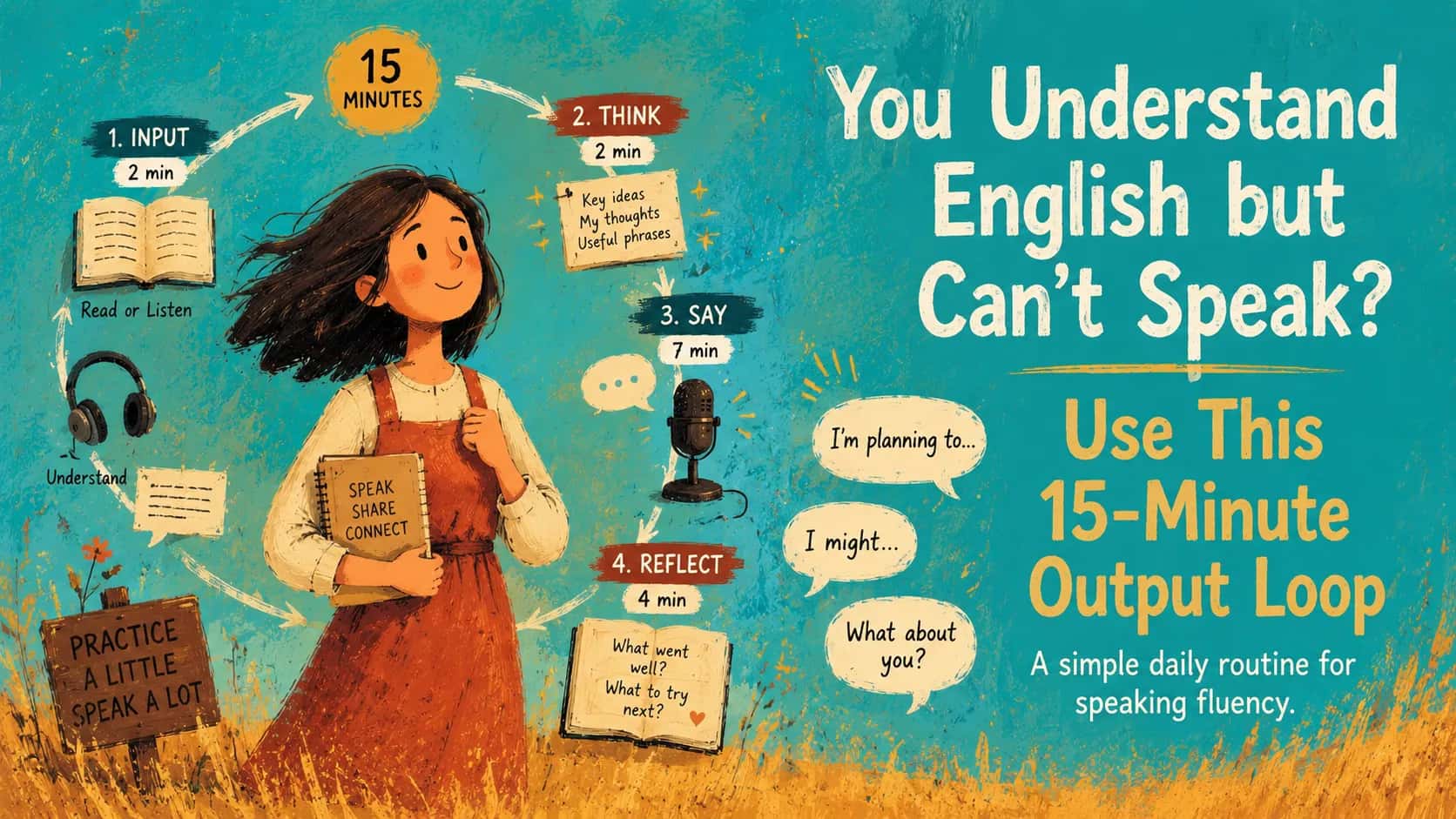
If you understand English but struggle to retrieve it quickly when speaking, Mynawoo’s guide Understand English but Can’t Speak? Try This 15-Minute Practice explains how to turn passive knowledge into faster output.
What if you forget a word during the interview?
Do not stop the whole answer for one missing word. Paraphrase, simplify, or repair the sentence. At B1, being able to keep communication moving matters more than producing the most advanced word.
Useful repair phrases:
- Let me say that another way.
- What I mean is…
- I don’t know the exact word, but…
- It’s a system/process/tool that…
- The main point is…
Example:
Instead of freezing because you forget deadline, say:
We had to finish the project by Friday.
Instead of searching for refund, say:
The customer wanted their money back.
That strategy is also useful outside interviews. The Mynawoo article How to Stop Translating in Your Head When Speaking a Foreign Language gives a broader practice method for faster meaning-to-speech retrieval.
Five interview mistakes B1 learners can fix quickly
1. Giving a one-sentence answer to everything
“Yes, I’m organised” gives the interviewer very little evidence. Add one example.
2. Trying to use advanced vocabulary you cannot control
A clear sentence you can explain is better than an impressive word you cannot use naturally.
3. Memorising a long script word for word
One unexpected follow-up can break the script. Use keyword cues instead.
4. Forgetting to connect examples to the role
After your example, add one sentence such as:
I think that experience would help me in this position because…
5. Practising silently
An interview is a speaking task. British Council guidance explicitly recommends practising responses aloud and doing a practice interview. Reading your answer is useful preparation, but it does not test real-time retrieval.
A 15-minute interview practice session
Use this routine when you have limited time.
Minutes 0–3: choose two questions
Pick one predictable question and one behavioural question.
Minutes 3–6: build keyword cues
Write four keywords for each answer. Do not write a full script.
Minutes 6–10: answer aloud
Give yourself five seconds to start. Record your answer if useful.
Minutes 10–13: repair one problem
Choose only one:
- unclear example;
- answer too long;
- too many pauses;
- repeated vocabulary;
- missing connector;
- weak ending.
Minutes 13–15: answer again
Say the same answer once more without reading.
The second attempt should be clearer, not necessarily more complicated.
A seven-day B1 job-interview practice plan
| Day | Focus | Practice |
|---|---|---|
| 1 | Tell me about yourself | Build a 45–60 second professional introduction |
| 2 | Motivation | Practise “Why this job?” using one job-description detail |
| 3 | Strength + weakness | Give one evidence-based strength and one improvement story |
| 4 | STAR | Prepare one problem-solving story |
| 5 | Fit | Practise “What can you bring?” and two follow-ups |
| 6 | Interaction | Do a short mock interview with changed question wording |
| 7 | Full run | Answer all seven questions with only keyword cues |
On Day 7, do not restart every time you make a grammar mistake. Finish the answer, then review the most important error afterward. That is closer to the pressure of a real interview.
How much English do you need for an interview?
There is no universal CEFR level required for “a job interview.” The language demand depends on the role, interviewer, industry, and how much professional English the job itself requires.
B1 can still be enough to communicate useful information in many predictable situations. The CEFR describes B1 speakers as able to discuss familiar matters such as work, give reasons and explanations, and maintain simple interaction, although hesitation and repair may still be visible. B2 involves more fluent, spontaneous interaction and more detailed explanation (Council of Europe: CEFR global scale).
So do not wait until your English feels “perfect.” Prepare the communication task you actually need.
Your interview checklist
Before the interview, make sure you can do these without reading a full script:
- introduce your professional background in under a minute;
- explain why you want this specific job;
- prove one strength with an example;
- describe one weakness and what you are doing about it;
- tell one short STAR story;
- connect your experience to the role;
- ask at least two useful questions;
- paraphrase when one word disappears.
If one item is difficult, practise that item—not the entire English language.
For a structured next step, use Mynawoo to practise speaking, grammar, vocabulary, listening, reading and writing inside a broader CEFR-aligned learning path, then return to these seven interview questions and answer them again without a script.
Suggested Posts


Author mobina
Wed Sep 30 2026
13 min read
How to Stop Translating in Your Head When Speaking a Foreign Language

Author baronsa
Fri Jul 24 2026
12 min read