

Understand English but Can’t Speak? Try This 15-Minute Practice

Author: baronsa
Fri Jul 24 2026 · 12 min read
Last updated: July 2026
If you understand English videos, articles, or lessons but freeze when it is your turn to speak, you probably do not need “more English” in general. You need a bridge from recognition to fast retrieval. The most useful fix is a short daily loop that makes you reuse a small set of words and grammar several times: first with support, then with less support, and finally in a real or simulated conversation.
This guide gives you that loop, a bottleneck diagnosis, a worked example, and a seven-day plan.
Why you can understand English but cannot speak it
Understanding and speaking are different jobs. While listening or reading, you can recognise meaning from context. While speaking, you must choose an idea, retrieve words, build a sentence, pronounce it, monitor the listener, and continue—all under time pressure.
The CEFR treats reception, spoken production, and spoken interaction as related but distinct language activities. In practical terms, being able to follow a conversation does not automatically mean you can produce the same language quickly. The goal is not to abandon listening and reading. It is to connect them to repeated, meaningful output.
Research on second-language oral fluency also describes it as multidimensional. Vocabulary access, sentence construction, articulation, and the type of speaking task can all affect how fluent someone sounds. That is why “just talk more” is incomplete advice. First identify what is slowing you down.
Diagnose your speaking bottleneck
| What happens when you speak? | Likely bottleneck | Best first response |
|---|---|---|
| You know the word when you see it but cannot recall it | Retrieval | Practise small phrase sets from memory |
| You know many words but sentences arrive in the wrong order | Grammar assembly | Reuse one sentence pattern in several meanings |
| You can write an answer but cannot say it smoothly | Articulation and timing | Repeat the same short task three times |
| You speak alone but freeze with people | Anxiety and interaction pressure | Start with low-stakes AI or recorded practice, then add a person |
| You give long answers but cannot manage interruptions or follow-up questions | Interaction skill | Practise short turns, clarification, and repair phrases |
| You practise often but on random topics | Lack of consolidation | Repeat one topic across several days |
You may have more than one bottleneck. Choose the one that most often stops the conversation and work on it for one week.
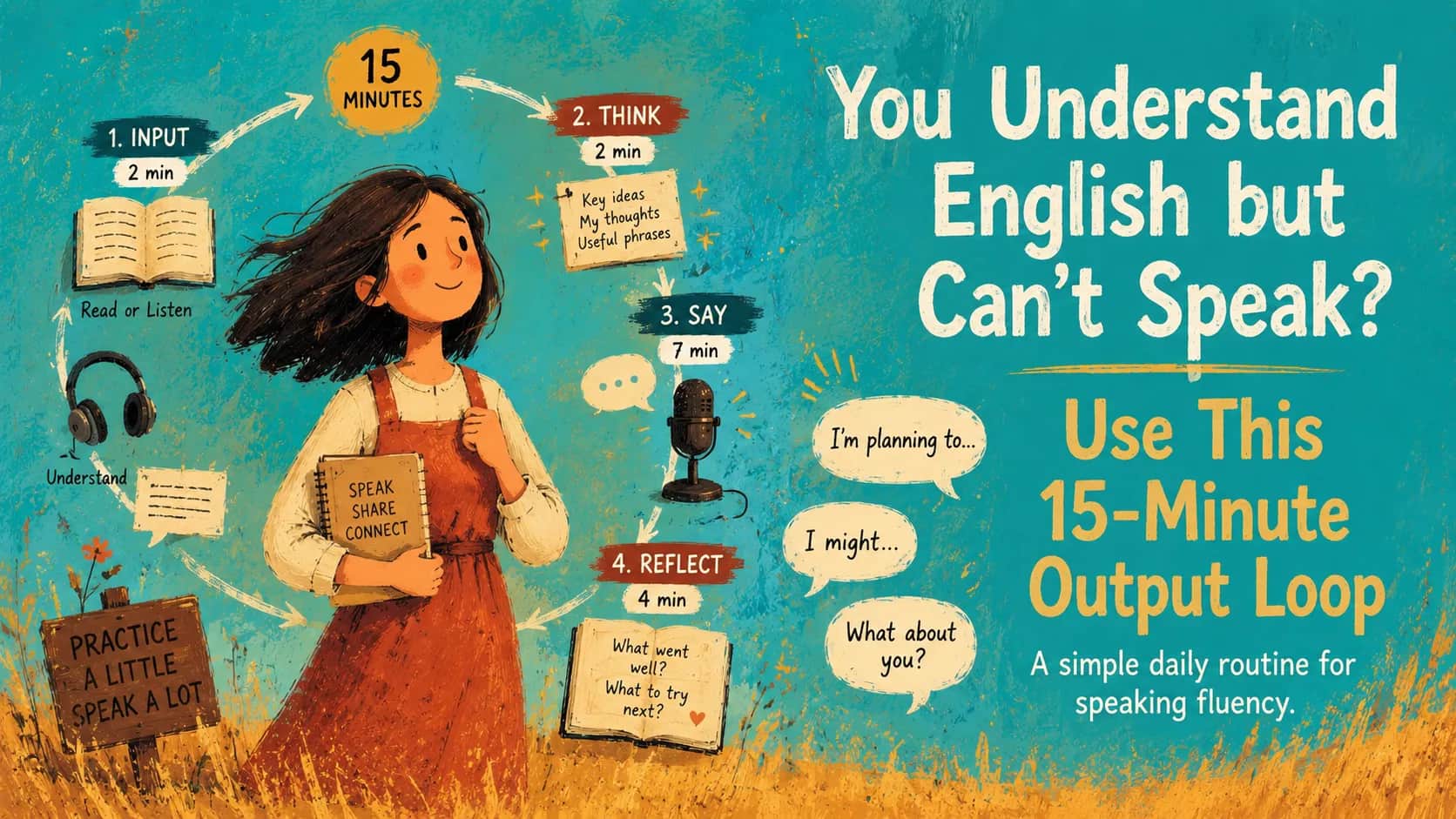
The 15-minute English Output Loop
The loop is simple: mine useful language, build a pattern, speak it three times, and repair one weakness. Keeping the material small allows your brain to retrieve and reorganise it instead of constantly starting from zero.
1. Mine five useful phrases — 3 minutes
Choose a short piece of level-appropriate English: a dialogue, listening clip, graded article, lesson, or transcript. Do not collect every unfamiliar word. Select five phrases you could realistically use this week.
Good phrases are portable:
- “I’m planning to …”
- “The main reason is …”
- “I’m not sure, but …”
- “Could you say that again?”
- “It depends on …”
A single phrase is more useful for speaking than an isolated word because it already contains grammar, word order, and a natural starting point.
2. Build one grammar pattern — 4 minutes
Choose one pattern from the input and change one element at a time.
For example:
- I’m planning to study tonight.
- I’m planning to call my sister.
- I’m planning to visit Istanbul next month.
- I’m not planning to work on Sunday.
- Are you planning to travel this summer?
This is grammar-first practice in a practical sense: grammar acts as a reusable map, but the map is immediately connected to meaning. You are not trying to explain the rule for ten minutes. You are using the rule to make several messages.
3. Speak the same task three times — 5 minutes
Use one prompt, such as: “What are your plans for the weekend?”
- Pass 1: supported. Look at your phrases and speak for 30–45 seconds.
- Pass 2: reduced support. Hide half the notes and speak again.
- Pass 3: no notes. Give the answer from memory, then answer one follow-up question.
Task-repetition research suggests repeated oral tasks can support immediate fluency changes because the first attempt is often spent deciding what to say. Repeating the task frees attention for smoother retrieval, clearer grammar, and fewer long pauses. Keep the topic the same; improve the delivery.
4. Repair only one weakness — 3 minutes
Listen to your recording or review feedback. Choose one target:
- one grammar error,
- one word you could not retrieve,
- one sentence that was too long,
- one pronunciation problem that affected clarity,
- or one missing interaction phrase.
Then say the corrected sentence three times and use it once in a new sentence.
Do not correct everything. Constant interruption can make speaking feel like a test instead of communication. A narrow repair target is easier to remember and reuse.
A worked example: talking about weekend plans
Suppose you understand a dialogue about weekend plans but cannot answer quickly.
Your five phrases
- “I’m planning to …”
- “I might …”
- “If the weather is good, …”
- “I haven’t decided yet.”
- “What about you?”
Your grammar map
Use different forms for different levels of certainty:
- I’m planning to visit a friend. — a current plan
- I might go to the beach. — a possibility
- If the weather is good, I’ll go for a walk. — a condition and likely result
- I haven’t decided yet. — no final decision
Your first answer
I’m planning to rest on Saturday because this week was busy. I might meet a friend in the evening. If the weather is good, we’ll walk near the sea. I haven’t decided what to do on Sunday yet. What about you?
Now repeat it with one change each time. On the second attempt, add a reason. On the third, answer a follow-up such as “Who are you going with?” or “What will you do if it rains?”
This small progression trains three abilities together: producing a connected answer, varying grammar to match meaning, and staying in the interaction.
Your seven-day speaking plan
Consistency becomes easier when every day has a clear output target. For one week, keep the same 15-minute structure while changing only the communicative task.
| Day | Speaking task | Grammar or phrase focus | Final output |
|---|---|---|---|
| 1 | Introduce yourself | present simple, “I work…”, “I’m interested in…” | 60-second introduction |
| 2 | Describe your routine | frequency phrases, time expressions | morning-to-evening description |
| 3 | Tell a recent story | past simple, sequence words | 90-second story |
| 4 | Explain a plan | going to, might, first conditional | weekend or travel plan |
| 5 | Give an opinion | “I think…”, “because…”, “however…” | answer with one reason and one contrast |
| 6 | Solve a problem | suggestions, polite questions | role-play a practical problem |
| 7 | Hold a conversation | clarification and follow-up phrases | five-minute AI or human conversation |
At the end of each session, record only three things:
- the task you completed,
- the phrase you successfully reused,
- the single repair target for tomorrow.
Do not score yourself as “fluent” or “not fluent.” Track evidence of behaviour: minutes spoken, repeated task completed, follow-up question answered, and repaired phrase reused.
How to use AI speaking practice without becoming dependent on it
AI can provide low-pressure repetition, flexible role-plays, and immediate opportunities to speak. It works best as a bridge to interaction—not as a complete replacement for conversations with people.
A 2025 mixed-methods study reported improvements in L2 speaking and reductions in speaking anxiety among learners using AI conversation bots. This is promising, but it does not mean every chatbot, prompt, or feedback style works equally well. The quality and regularity of the task still matter.
Use AI for:
- rehearsing the same situation several times,
- changing the difficulty of follow-up questions,
- practising at a specific CEFR level,
- receiving feedback after you finish speaking,
- generating role-plays connected to work, travel, study, or daily life,
- and building confidence before a human conversation.
Then use a person for:
- faster turn-taking,
- interruptions and overlapping speech,
- humour and unexpected reactions,
- negotiation of meaning,
- and the social pressure of real communication.
The Council of Europe’s work on spoken and online interaction also supports an action-oriented view: learners need to do things with language, respond to others, and manage communication—not only produce correct standalone sentences.
A useful AI prompt for speaking practice
Use a prompt like this:
Act as a friendly English conversation partner for an A2 learner. Ask one question at a time about weekend plans. Keep your sentences short. Do not correct me while I am answering. After five turns, give me feedback on only one grammar pattern, one useful phrase, and one clarity problem. Then ask me to repeat the conversation using the corrections.
The key is delayed, selective feedback. You need enough uninterrupted speaking to build flow, followed by a small repair task you can actually repeat.
How to choose a speaking-consistency app or tool
A useful language-learning speaking tool should reduce friction between learning a phrase and using it. Look for these capabilities:
- Level control: prompts and feedback that match your current ability.
- Repeatable tasks: the option to practise the same situation again, not endless random topics.
- Delayed feedback: correction after a speaking turn or task.
- Grammar connection: explanations that help you rebuild the sentence, not only label it wrong.
- Phrase review: a way to revisit words and expressions over time.
- Skill connection: listening or reading that feeds directly into speaking.
- Progress evidence: completed tasks, recurring errors, or learning analytics.
- Transfer to real life: role-plays and questions that resemble situations you actually face.
Avoid choosing only by the number of lessons, streak animations, or how “advanced” the AI sounds. The better question is: Does this tool make me retrieve, speak, repair, and reuse language consistently?
Common mistakes that keep the speaking gap open
Consuming more input without an output deadline
Listening is valuable, but passive exposure can become comfortable avoidance. Add a rule: after every short input, produce a 30–60 second response using three phrases from it.
Memorising isolated vocabulary
Knowing that decision means something is different from quickly saying “I haven’t made a decision yet.” Store and review words inside useful chunks.
Changing topics every day
Novelty feels productive, but repeated tasks reveal progress. Revisit the same situation with new details, a stricter time limit, or harder follow-up questions.
Correcting every sentence while speaking
Accuracy matters, but constant self-editing overloads the task. Finish the message first. Repair one important pattern afterward.
Waiting to feel confident
Confidence often follows successful repetitions; it does not always arrive before them. Make the first task small enough to complete even when you feel nervous.
Treating fluency as speed
Fast speech with unclear meaning is not the goal. Aim for connected ideas, manageable pauses, understandable pronunciation, and the ability to respond when the conversation changes.
Where grammar-first learning fits
Grammar helps when it becomes a fast decision tool:
- past simple for a finished event,
- present perfect for experience or a past event connected to now,
- going to for a plan,
- might for possibility,
- conditionals for consequences,
- polite indirect questions for social distance.
But grammar alone does not create speaking ability. Pair each grammar point with listening or reading, phrase retrieval, repeated output, feedback, and a real communicative task.
Mynawoo is designed around that connected path: grammar, reading, listening, writing, speaking, smart flashcards, the Leitner system, personalised practice, and learning analytics. After completing the seven-day plan, a sensible next step is to explore Mynawoo and use a structured learning path to keep input, grammar, review, and output connected.
For a broader level-based plan, read The CEFR Roadmap from A2 to B2. To compare learning systems rather than speaking drills, see the Duolingo alternative guide for professionals. More practical guides are available in Mynawoo Mag.
Frequently asked questions
How long does it take to start speaking English more easily?
There is no reliable universal deadline. Many learners notice that repeated tasks feel easier within a few sessions, but broader speaking progress depends on current level, practice quality, frequency, anxiety, vocabulary access, and opportunities for interaction. Measure smaller changes first: fewer long pauses, faster phrase retrieval, longer connected answers, and better responses to follow-up questions.
Should I practise speaking English every day?
Daily practice can help when it is short and sustainable. Ten to fifteen focused minutes is often more practical than a long session you rarely repeat. Keep one minimum action for busy days: record a 30-second answer, repair one sentence, and say it again.
Can I improve speaking English by talking to myself?
Yes, self-talk and recording are useful for rehearsal, retrieval, and noticing gaps. They cannot fully train turn-taking or unpredictable interaction, so add AI or human conversations after you can complete the task alone.
Should I focus on grammar or fluency first?
Do not treat them as enemies. During the first speaking attempt, prioritise completing the message. Afterward, repair one grammar pattern that changes meaning or repeatedly causes confusion. Then repeat the task so the correction becomes usable speech.
Is AI enough for English speaking practice?
AI can be a valuable low-pressure practice partner, especially for repetition and role-play. It should be combined with real human interaction when possible because people create different demands: shorter turns, interruptions, social cues, negotiation, and genuinely unexpected responses.
The speaking gap closes when familiar English becomes retrievable English. Keep the material small, repeat the same meaningful task, repair one weakness, and gradually increase the pressure from notes, to no notes, to AI, to a real person.
Suggested Posts


Author baronsa
Fri Oct 02 2026
13 min read
Mynawoo Lessons Version 2 Arrives October 15: A New Standard for How We Teach Languages

Author baronsa
Tue Nov 04 2025
8 min read