
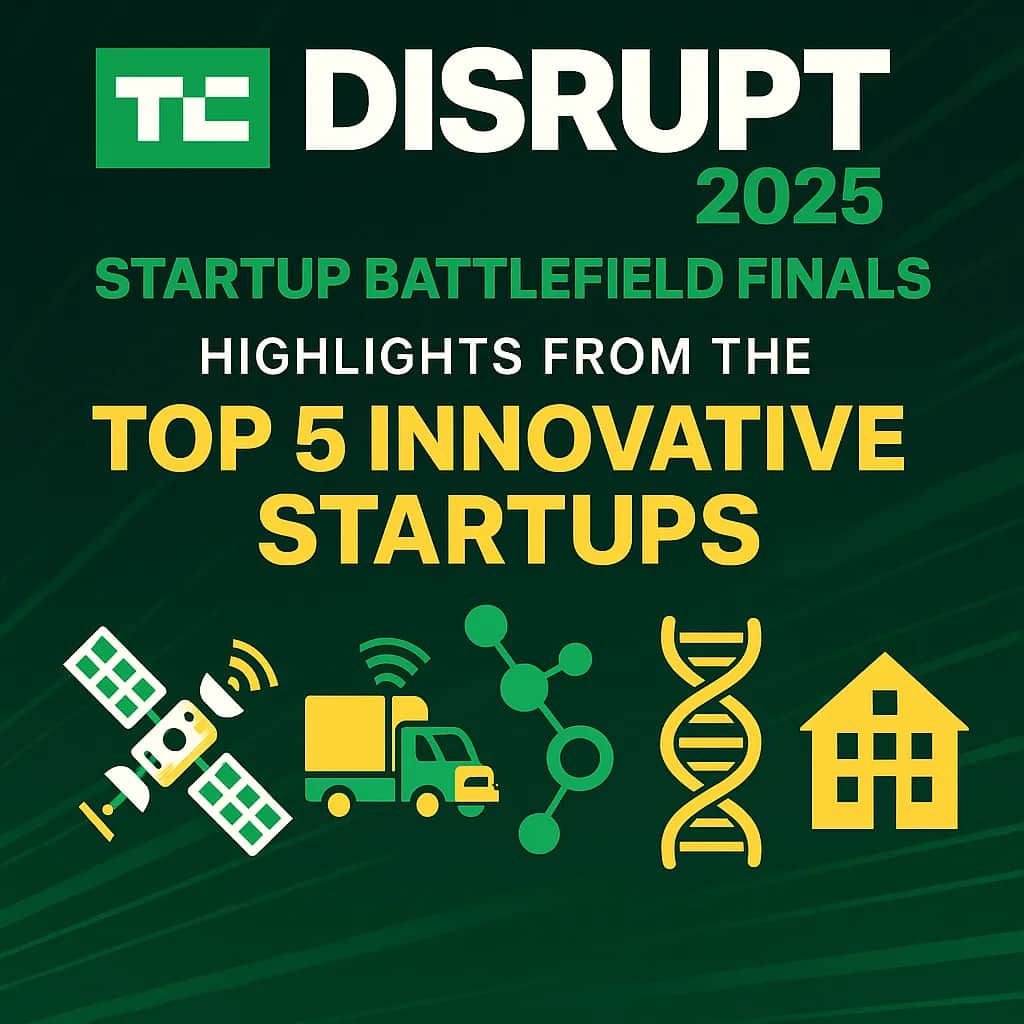
TechCrunch Disrupt 2025 Startup Battlefield Finals: Highlights from the Top 5 Innovative Startups

Author: baronsa
Tue Nov 04 2025
7 min read
TechCrunch Disrupt 2025 Startup Battlefield Finals: Highlights from the Top 5 Innovative Startups
TechCrunch Disrupt 2025 brought together the world's most promising startups for the highly anticipated Startup Battlefield finals. Held on November 4, 2025, this event showcased 5 finalists competing for a $100,000 equity-free prize and the coveted Startup Battlefield Cup. With live pitches, demos, and intense Q&A sessions from an all-star panel of judges—including Kevin Rose (True Ventures), Aileen Lee (Cowboy Ventures), Marlon Nichols (MaC Venture Capital), Kevin Hartz (A* Capital), and Kirsten Green (Forerunner Ventures)—the finals highlighted groundbreaking innovations in space fintech, logistics, sustainable textiles, gene therapy, and real estate tech.
In this article, we'll dive into the key highlights from each finalist's pitch, their unique solutions, and the judges' probing questions. If you're interested in emerging startups, disruptive technologies, or venture capital trends, read on for an in-depth recap of TechCrunch Disrupt 2025's Startup Battlefield.
What is TechCrunch Disrupt's Startup Battlefield?
TechCrunch Disrupt is one of the premier tech conferences, drawing entrepreneurs, investors, and innovators globally. The Startup Battlefield is its flagship competition, where early-stage startups pitch their ideas to win funding and visibility. In 2025, over 20 startups initially competed, but only the top 5 made it to the finals. Each had 6 minutes to pitch and demo, followed by an 8-minute Q&A.
This year's theme emphasized real-world problem-solving, from space economy challenges to environmental sustainability. The $100,000 prize is equity-free, allowing winners to scale without dilution. Past winners like Dropbox and Mint have gone on to massive success, making this a launchpad for unicorn potential.
Charter Space: Revolutionizing Space Fintech and Insurance
Founder and CEO: Yuqi Chen
Charter Space tackles the "money problem" in space: only 300 of over 14,000 satellites are insured, exposing $150 billion in assets. By 2030, this risk could triple, stalling the space economy without proper insurance and credit.
Their platform uses real-time engineering data from spacecraft builds to assess risks, helping engineers reduce uncertainties, investors gain security, and insurers price policies confidently. Drawing parallels to Lloyd's of London, Charter aims to build financial infrastructure for space exploration.
Key Demo and Highlights
- Demoed a satellite from the University of Washington's Husky Satellite Lab, showing real-time subsystem tracking and AI-powered risk analysis.
- Partnerships with NASA, JPL, and top space insurers; over two dozen satellites being built on their software.
- Acquired a YC-backed insurance brokerage to bind policies directly.
Judges' Q&A Insights
Judges praised the GitHub-like tracking of hardware changes for de-risking. Chen explained AI's role in structuring data (not direct risk analysis) and emphasized pre-launch focus to correlate with failure rates. Market size: $15B today, growing to $50B by decade's end. Competition? Mostly manual processes and Excel.
Charter Space positions itself as the bridge between engineering, insurance, and finance, with plans for credit and debt products.
Glide: The Future of Road-to-Rail Logistics
Founder and CEO: Kevin DeMao
Glide addresses congested roads and underutilized rails with autonomous vehicles that eliminate transloading inefficiencies. Traditional transloading uses cranes, forklifts, and multiple moves, taking 2-6 weeks and costing heavily.
Glide's solution: Two vehicles—Raiden (autonomous for contested logistics) and Glider M (for commercial 20-foot containers)—plus software for seamless road-to-rail transitions.
Key Demo and Highlights
- Live demo of Raiden lifting trailers and Glider M handling containers.
- Patent-pending tech with sensor fusion for track inspection and debris avoidance.
- Business model: Mobility-as-a-Service at $300K/year per vehicle + ton-mile fees.
- Traction: 5 pilots, $70M in commitments; $6.7M projected revenue next year.
Judges' Q&A Insights
DeMao highlighted go-to-market in industrial parks and short-line railroads, with no resistance due to increased utilization. Economics: 62% cost savings for customers; vehicles pay back in 6-8 months. Scaling involves partnerships with PACCAR and Custom Truck for 10-36 units per deployment.
Glide's hybrid vehicles (300kWh battery + range extender) target ports, railroads, and defense, aiming to re-industrialize logistics on Earth and beyond.
Macrocycle: Enabling Circular Economy in Textiles
Co-Founder and CEO: Stuart Peña Feliz
Over 99% of textiles end up in landfills, oceans, or incinerated—a $3T linear economy polluting with microplastics. Current recycling from bottles is limited; advanced methods are energy-intensive and costly.
Macrocycle's patented "cyclogenesis" process makes new bonds instead of breaking them, retaining polymer energy to create macrocycles. This bypasses petrochemical steps for high-quality, cost-parity recycled polyester.
Key Demo and Highlights
- Live decolorization demo in Cambridge, MA: Extracting dyes from textiles to yield clear polyester.
- Scaled 1,500x to industrial demo plant; $350K ARR from fashion/footwear customers.
- Goal: Recycle half of San Francisco's yearly textile waste by decade's end ($10M+ revenue).
Judges' Q&A Insights
Peña Feliz confirmed path to price parity at 10,000 tons/year ($35M capex) vs. competitors' $1B facilities. Customers: Fast fashion brands; sourcing from Goodwill and post-industrial waste. Waste output: Contaminants valorized where possible; product infinitely recyclable.
Backed by MIT talent, Macrocycle leverages contract manufacturing for rapid scaling in sustainable textiles.
Nephrogen: AI-Powered Gene Delivery for Kidney Disease
Co-Founder and CEO: Dimitri Maxim
Gene therapies have cured patients but none target kidneys due to complex cell types and filtration barriers. Kidney disease affects 10% globally, killing 100,000 US annually and costing Medicare $86B.
Nephrogen's NEO-AP vectors use AI and high-throughput screening to deliver genes precisely, starting with kidneys but expandable.
Key Demo and Highlights
- Showed diseased vs. healthy kidneys; vectors transduce in mice and (first-time) human ex-vivo tissue.
- Two-tier model: License vectors to pharma ($600K+ from Merck, BMS); develop own therapies for polycystic kidney disease.
- Team from Harvard/Stanford; raising seed round.
Judges' Q&A Insights
Maxim clarified vectors as "FedEx trucks" for CRISPR cargos. Timeline: Licensing generates immediate revenue (up to $50M upfront); royalties on approvals. Validation: Mouse to monkey to human systems. AI screens billions of variants for organ-specific delivery.
Nephrogen aims to reverse kidney disease, unlocking cures for untreatable conditions.
Unlisted: Unlocking the 98% of Homes Not for Sale
Founder and CEO: Katie Hill
Real estate platforms focus on 2% of homes for sale, ignoring the $31T "shades of gray" where owners might sell under right conditions.
Unlisted profiles all 121M US properties, letting buyers waitlist dream homes and owners control profiles/timelines.
Key Demo and Highlights
- Platform demo: Search every home, join waitlists, edit profiles.
- Revenue: Realtor ads/subscriptions ($1M contracts by year-end); data sales to advertisers like Home Depot.
- Traction: 1.42M profiles viewed; $8B in waitlisted homes; $1.2B in updated properties.
Judges' Q&A Insights
Hill explained seller engagement via email/direct mail (10% response). Data value: Timelines predict moves ($36M commissions in pipeline). Differentiation: Avoids MLS restrictions; positions as data company, not brokerage.
Unlisted disrupts real estate with proactive matching, ripe amid industry shakeups.
Wrapping Up TechCrunch Disrupt 2025: Who Will Win the Battlefield?
The finals showcased diverse innovations tackling trillion-dollar markets. While the winner wasn't announced in this transcript, the event underscores the vibrancy of startup ecosystems. Stay tuned for updates on TechCrunch Disrupt winners and follow these finalists for future breakthroughs.
If you're a founder or investor, events like this highlight opportunities in space tech, logistics automation, sustainable materials, biotech, and proptech. For more on TechCrunch Disrupt 2025 highlights, check out related coverage on emerging startups and venture trends.
Tags:
Suggested Posts


Author baronsa
Tue Nov 25 2025
3 min read
How to Learn Sanskrit Easily — The Real Challenges, and How Mynawoo Makes It Simple


Author mona
Mon Oct 27 2025
8 min read
🧠 The Science of Spaced Repetition: How to Remember Anything Longer
Tags:
#AI