

How to Stop Translating in Your Head When Speaking a Foreign Language


Author: mobina
Wed Sep 30 2026
13 min read
If you build a sentence in your native language, translate it word by word, check the grammar, and only then speak, the solution is not to ban your first language. The better goal is to build faster routes from meaning → familiar chunks → speech so translation becomes optional instead of mandatory.
For A2–B1 learners, that usually means practising a small number of useful phrases in situations, retrieving them under gentle time pressure, and repeating the same speaking task until the language comes out with less assembly.
The short answer: how do you stop translating in your head?
Do not try to “switch off” your native language. Train a shorter route to speech. Learn useful expressions as whole chunks, connect them to situations rather than isolated translations, retrieve them without looking, and use them in short timed responses. With repetition, more familiar language can become available directly from meaning.
That is different from pretending your first language no longer exists. Research on bilingual processing shows that both languages can remain active during second-language use. A 2014 speech-production study found evidence that bilingual speakers accessed phonological information from their non-target language even while producing only the second language (PubMed). More recent research also shows that the relationship between first-language translation knowledge and second-language lexical retrieval changes with proficiency rather than following one simple rule (Cambridge University Press).
So the useful target is not “zero L1 activation.” It is faster, more reliable access to the L2 you already know.
First, diagnose what “translating in my head” actually means
Learners often use one phrase for several different problems. Before changing your practice, identify which delay you experience most often.
| What happens in conversation | Likely bottleneck | Best training focus |
|---|---|---|
| You know the idea but cannot find the word | Lexical retrieval | Recall + paraphrase |
| You find words but build the sentence very slowly | Sentence assembly | Reusable chunks + sentence frames |
| You mentally check every tense/article/preposition | Monitoring overload | Simpler first draft + delayed correction |
| You can answer eventually, but the conversation moves on | Retrieval speed | Short timed responses |
| You understand the question but freeze under pressure | Interaction load | Repeated low-stakes speaking |
This matters because “learn more vocabulary” is not the right answer to every pause. You may already know enough language to answer but not be able to retrieve and assemble it quickly.
Research on second-language utterance fluency separates several processes that contribute to fluent speech, including lexical retrieval, syntactic encoding, articulation, pauses, and repair (Cambridge University Press). That is a useful practical reminder: hesitation can come from more than one place.
The Direct-Response Loop: Meaning → Chunk → Time → Interaction
Use this four-part loop with language you already partly know. The aim is not perfect sentences. The aim is to reduce how much construction has to happen in real time.
1. Meaning: start from a situation, not a translation pair
Suppose you are learning English and want to talk about a late bus.
A translation-heavy study card might be:
miss the bus = [native-language equivalent]
That can be useful for first understanding. But for speaking practice, add a direct situation:
- picture yourself arriving as the bus leaves;
- hear: “I missed the bus”;
- connect it with: “I was late because I missed the bus.”
Now the phrase has more than a bilingual word pair attached to it. It has a scene, a cause, and a sentence pattern.
Your first language can still be present. The key is that it is no longer the only path to the phrase.
The Council of Europe’s CEFR explicitly treats a learner’s languages as an interconnected repertoire rather than insisting that languages stay in sealed mental boxes. Its plurilingual perspective describes learners as social agents who draw flexibly on their linguistic resources (Council of Europe). That supports a more realistic goal: use your stronger language when it helps, while steadily increasing what you can do directly in the target language.
2. Chunk: store useful language in pieces larger than one word
Real speech is easier when you do not have to construct every sentence from individual words.
Instead of memorising only:
- probably
- depends
- agree
- reason
practise:
- It probably depends on…
- I agree because…
- The main reason is…
- I’m not sure, but…
- What I mean is…
- Let me think for a second.
These are not scripts for every conversation. They are launching pads. They buy time and reduce the number of choices your brain must make at once.
Try a “three-context test” for a new chunk. Can you use it in three different situations?
For It depends on…:
- “Is online learning better?” → “It depends on your goal.”
- “Should I study at night?” → “It depends on your schedule.”
- “Is this word formal?” → “It depends on the context.”
If a phrase survives three contexts, it is becoming a tool rather than a memorised sentence.
3. Time: retrieve before you have time to translate everything
Translation often becomes dominant because the learner always practises with unlimited time.
Add gentle, not stressful, time pressure.
Ask yourself:
What did you do this morning?
Give yourself five seconds to begin. Your first sentence can be simple:
“I woke up late and made coffee.”
Then add one detail:
“I woke up late, made coffee, and checked my messages before work.”
The five-second limit is only for starting, not for finishing perfectly. It trains you to launch with available language instead of waiting for an ideal sentence.
Use three rounds:
- Round 1 — 30 seconds: say anything understandable.
- Round 2 — 30 seconds: repeat the same answer more smoothly.
- Round 3 — 30 seconds: add one useful detail or connector.
The topic stays the same, so your attention can shift from “What do I say?” toward “Can I access it faster?”
A practical rule: simplify before you translate
When the perfect word is missing, do not immediately return to your first language.
If you cannot retrieve exhausted, say:
“I was very tired.”
If appointment disappears, say:
“I had to meet the doctor at three.”
If you cannot remember refund, try:
“I want my money back.”
This is not bad language. It is communication strategy.
A learner who can paraphrase stays inside the conversation. A learner who insists on one exact word may stop the whole interaction.
4. Interaction: practise responses, not just monologues
You can sound fluent alone and still struggle when another person controls the conversation.
Add short unpredictable follow-ups:
Prompt: “What did you do last weekend?” Answer: “I stayed home on Saturday, but I went out on Sunday.”
Then immediately answer:
- “Why did you stay home?”
- “Who did you go out with?”
- “Would you do the same next weekend?”
- “What was the best part?”
This trains the real problem: retrieving language after the direction changes.
The CEFR places interaction alongside reception, production, and mediation, reflecting that real communication often combines several modes rather than one isolated skill (Council of Europe).
What should you do when translation starts mid-sentence?
Do not panic and do not restart from the beginning.
Use a repair move:
- Let me say that another way.
- I mean…
- It’s like…
- I don’t know the word, but…
- The thing you use for…
- What I’m trying to say is…
Then simplify.
Example:
“Yesterday I went to the… the place where you send packages.”
You communicated the idea even without post office. If your partner supplies the word, repeat it naturally:
“Yes, the post office. I went to the post office yesterday.”
That sequence—gap → paraphrase → supplied word → immediate reuse—turns a failure into retrieval practice.
Should you learn vocabulary with translations?
Yes, when translation gives you fast and accurate access to meaning.
The mistake is not using a translation. The mistake is ending the learning process there.
Try this progression:
Stage 1 — Understand
Target phrase → short native-language meaning.
Stage 2 — Situate
Target phrase → one concrete scene or example.
Stage 3 — Retrieve
Meaning or situation → target phrase without looking.
Stage 4 — Vary
Use the phrase in a new sentence.
Stage 5 — Interact
Use it in response to a question you did not fully plan.
For active vocabulary, this is more useful than reviewing the same bilingual pair repeatedly.
If vocabulary retrieval is the main bottleneck, use Mynawoo’s guide How to Learn Vocabulary That You Can Actually Use alongside this routine.
A 15-minute anti-translation speaking session
You do not need an hour of conversation.
Minutes 0–3: choose five chunks
Choose five expressions connected to one situation, such as giving opinions:
- I think…
- It depends on…
- The main reason is…
- For example…
- I’m not sure, but…
Read them aloud once. Then cover them.
Minutes 3–6: retrieve from meaning
Look at five short prompts:
- give your opinion;
- show uncertainty;
- give a reason;
- add an example;
- avoid a yes/no answer.
Produce the matching chunk without looking.
Minutes 6–10: one-minute answers
Answer four familiar questions. Give yourself five seconds to start each answer.
Do not stop to correct every mistake.
Minutes 10–13: repeat one answer
Choose the hardest answer and say it three times. Each repetition should be a little easier, not necessarily more complicated.
Minutes 13–15: repair drill
Take three words you often forget. Practise explaining each without saying the word itself.
For umbrella:
“It’s something you carry when it rains.”
For receipt:
“It’s the paper a shop gives you after you pay.”
The goal is to make “I forgot the word” a detour, not a dead end.
Why “think only in the target language” is weak advice
The advice sounds simple but gives you no behaviour to practise.
You cannot directly command your brain to stop activating a language you know well. Bilingual lexical research repeatedly finds cross-language activation, and the effect depends on factors such as proficiency, exposure, task, and the words themselves. A 2024 Cambridge study found that first-language translation knowledge could interfere with or facilitate second-language retrieval depending partly on proficiency (Cambridge University Press).
So use a measurable goal instead:
- Did I begin my answer faster?
- Did I retrieve more phrases directly?
- Could I paraphrase when a word disappeared?
- Did I finish the thought without switching languages?
- Was the second attempt easier than the first?
These are trainable.
Do not confuse this with banning your mother tongue
For beginners especially, the first language can explain a grammar contrast or difficult concept quickly. For intermediate learners, a translation can verify meaning efficiently. And bilingual speakers do not become successful by pretending their linguistic history has vanished.
Mynawoo’s guide Native Language vs Immersion: When to Use Each goes deeper into when native-language support is useful and when more direct target-language processing is worth practising.
A good rule is:
Use your native language to understand faster; use the target language to retrieve and communicate more often.
Those goals are compatible.
A 7-day experiment
Use one recurring topic each day so you can notice changes in access speed.
| Day | Focus | Task |
|---|---|---|
| 1 | Baseline | Record a 60-second answer with no preparation |
| 2 | Chunks | Extract five reusable phrases from your answer |
| 3 | Retrieval | Recall those phrases from meanings/situations |
| 4 | Speed | Start five answers within five seconds |
| 5 | Paraphrase | Explain five missing words without translating |
| 6 | Interaction | Answer follow-up questions on the same topic |
| 7 | Repeat | Record the Day 1 prompt again |
Compare Day 1 and Day 7.
Do not judge your accent or count every grammar error. Listen for:
- faster starts;
- fewer long silent searches;
- more complete thoughts;
- better paraphrasing;
- less need to mentally compose a full L1 sentence first.
If those improve, your processing route is changing even if translation has not disappeared.
Common mistakes
Trying to eliminate translation in one week
Translation is not a bad habit you can simply forbid. Build alternatives repeatedly.
Learning isolated words but expecting fluent sentences
A large vocabulary helps, but real-time speech also needs chunks, grammar patterns, and retrieval speed.
Practising only topics you can already discuss comfortably
Easy repetition helps fluency, but eventually add one new situation at a time.
Correcting yourself after every word
Too much monitoring can make a simple answer harder to produce. Finish the message first, then repair one or two important errors.
Choosing material far above your level
If every response requires ten unknown words, you will rely more heavily on translation because you do not yet have enough accessible language for the task.
Treating pauses as failure
Native and highly proficient speakers pause too. The useful question is whether you can keep meaning moving.
How this fits with CEFR progress
CEFR levels are not defined by whether you “think in the language.” They describe what learners can do across communicative activities and competences. The framework emphasises usable communication, interaction, strategies, and a learner’s developing plurilingual repertoire (Council of Europe).
For an A2 learner, success may mean giving short connected answers with familiar language. At B1, the learner is expected to handle a broader range of familiar situations and sustain communication more independently. The practical bridge is not a magical moment when translation vanishes. It is a growing collection of language that can be retrieved quickly enough to use.
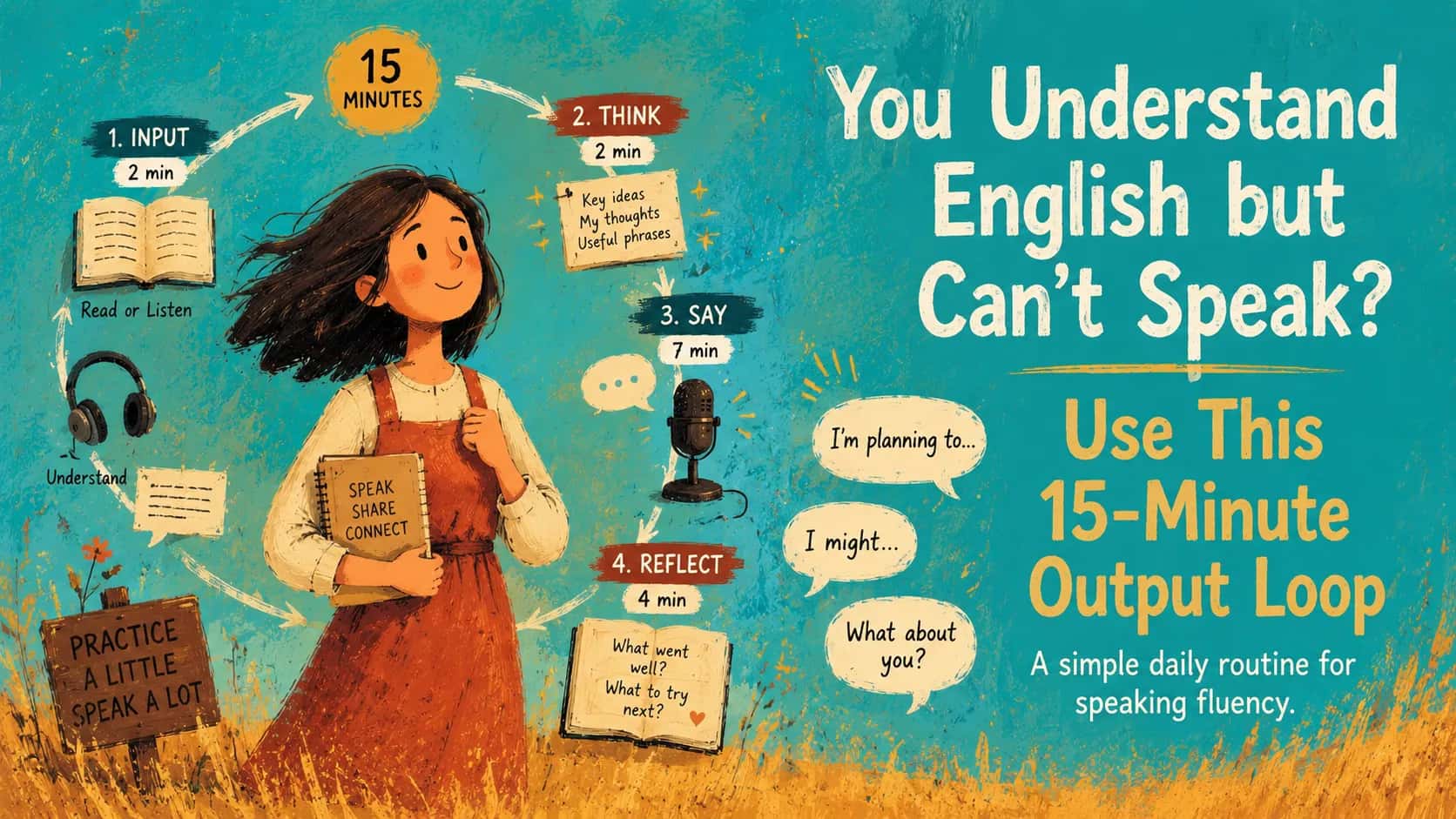
If your bigger problem is that you understand English but cannot produce it consistently, read Understand English but Can’t Speak? Try This 15-Minute Practice next. That guide focuses on converting passive knowledge into output; the routine here focuses specifically on reducing the translation bottleneck during real-time speech.
Your rule for the next conversation
When someone asks you a question, do not wait for the perfect translated sentence.
Start with the simplest target-language version you can access.
Use a chunk.
Add one detail.
Paraphrase the missing word.
Keep the meaning moving.
Your first language can remain part of your linguistic repertoire. Progress is when the target language no longer needs to pass through it every single time.
Suggested Posts

Author baronsa
Fri Jul 24 2026
12 min read
Understand English but Can’t Speak? Try This 15-Minute Practice

Author baronsa
Mon Oct 27 2025
9 min read