
General AI vs Specialized AI: Which Is Better for Language Learning?

Author: baronsa
Sun Aug 17 2025
9 min read
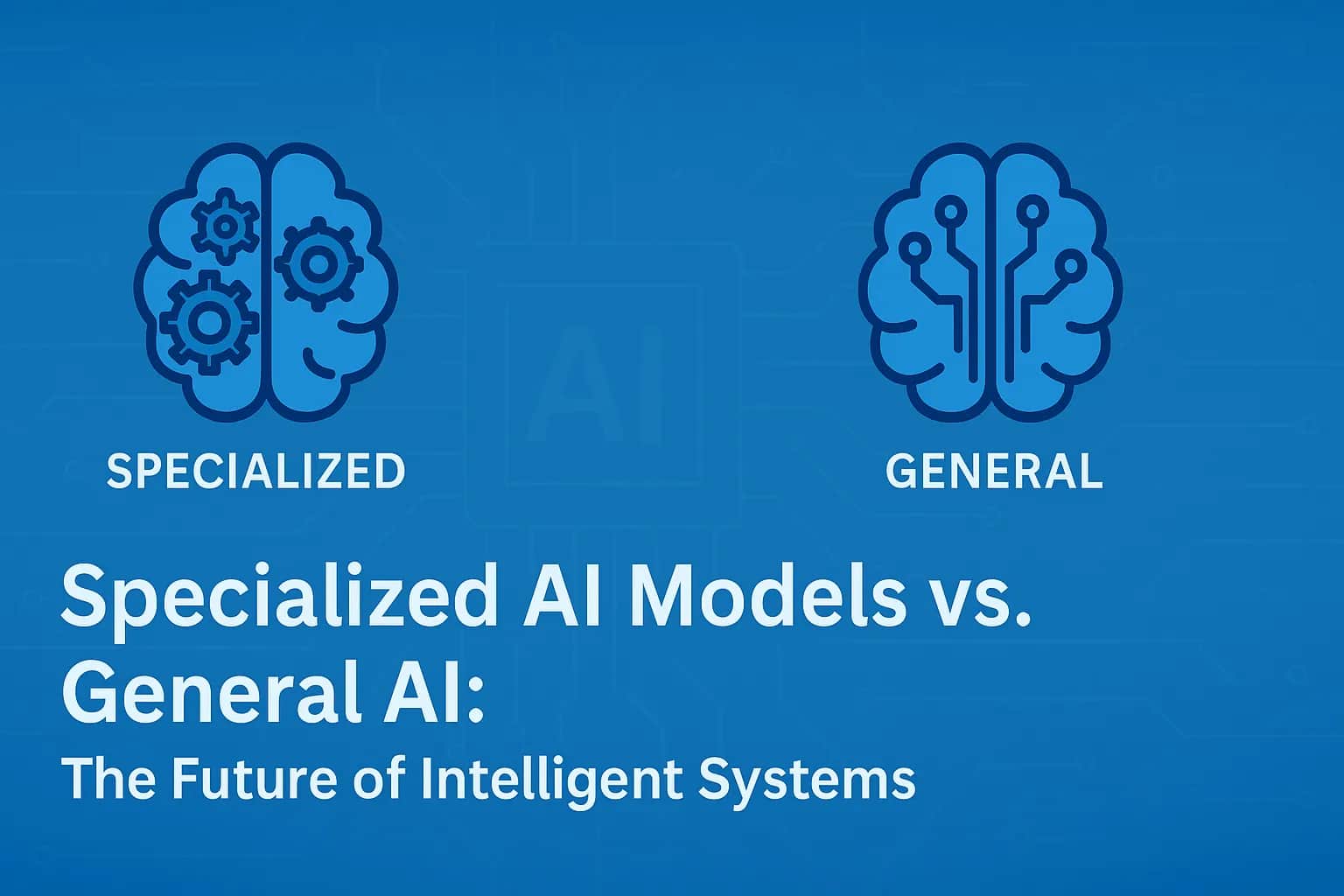
“Specialized AI” sounds as if it must be a completely different kind of model from general-purpose AI. In practice, the distinction is more useful when you think about the whole system, not only the base model.
A general foundation model can answer questions across many domains. A specialized AI system may start from a similar foundation model but add domain-specific prompts, curated data, retrieval, tools, workflow rules, fine-tuning, or evaluation criteria designed for one job.
That matters in language learning because a flexible chatbot and a structured learning system solve different problems.
General AI vs. specialized AI: the short answer
General AI is useful when you need breadth, open-ended conversation, explanation, brainstorming, translation, or help across many unrelated tasks.
Specialized AI is useful when the job has clear constraints, domain knowledge, repeated workflows, quality checks, or progress that must persist over time.
Neither category automatically wins.
A specialized system can be worse if its data, rules, or evaluation are poor. A powerful general model can outperform a weak domain system on many tasks. The advantage comes from how well the system is adapted to the job—not from the label “specialized.”
What “specialized AI” actually means
Specialization can happen in several ways.
1. Better instructions and workflow constraints
A general model can become much more reliable for one task when the system defines exactly what it should do, what format to return, what sources to use, and what it must not invent.
For example, a language-learning workflow can require:
- explanations at a specific CEFR level;
- examples in the target language;
- explanations in the learner’s teaching language;
- a fixed lesson sequence;
- answer validation before advancing;
- feedback that focuses on one error at a time.
No model weights need to change for this kind of specialization.
2. Retrieval from trusted domain content
A system can retrieve information from a curated knowledge base and give that context to a general model. This is often called retrieval-augmented generation, or RAG.
For language learning, retrieval might include:
- the current lesson content;
- a course grammar map;
- previously learned vocabulary;
- the learner’s recent errors;
- approved examples and explanations.
This can make responses more grounded without retraining the base model.
3. Fine-tuning
Fine-tuning changes a model using additional training data. Official documentation from Google Cloud and AWS describes fine-tuning as one way to adapt foundation models to particular tasks or domain-specific language.
Fine-tuning can be valuable, but it is not automatically the first or best solution. Prompting, retrieval, tools, and evaluation may solve the problem with less complexity.
4. Tools and deterministic logic
A specialized system can combine an AI model with ordinary software.
A language platform might use deterministic code to:
- select the next lesson;
- track completed exercises;
- schedule review;
- score objective questions;
- enforce course prerequisites;
- store progress.
The model then handles the parts where language generation or interpretation is useful.
5. Domain-specific evaluation
This is one of the most important forms of specialization.
A system is not truly improved for a domain merely because its prompt mentions that domain. It should be evaluated on tasks that matter for that domain.
For a language-learning system, useful evaluations might ask:
- Is the explanation appropriate for the learner’s level?
- Is the target-language example natural and correct?
- Did the system preserve the learner’s teaching language?
- Does the exercise test the skill it claims to test?
- Is the feedback actionable?
- Does the next activity build on what the learner already studied?
A practical comparison
| Need | General-purpose AI | Specialized language-learning system |
|---|---|---|
| Open-ended questions | Excellent fit | Can be more constrained |
| Conversation on any topic | Strong | Strong if conversation is part of the design |
| Fixed curriculum | Must be prompted or supplied | Can be built into the product |
| Persistent progress | Requires external state | Can be native to the system |
| CEFR sequencing | Possible with context | Can be designed around it |
| Review scheduling | Needs tools/state | Can be integrated |
| Error tracking over time | Needs memory/data layer | Can be part of learner analytics |
| Controlled lesson format | Possible | Usually easier to enforce |
| Broad non-language tasks | Strong | Not the main purpose |
The table is not a claim that specialized systems always perform better. It shows that the product architecture can make certain repeated tasks easier to control.
Why language learning benefits from specialization
A useful language-learning system must do more than answer “What does this word mean?”
It has to manage progression.
A learner may need to:
- encounter a pattern;
- understand it;
- recognise it in reading or listening;
- retrieve it from memory;
- use it in speech or writing;
- receive feedback;
- meet it again later.
A general chatbot can help with each step independently. A specialized platform can connect the steps into one sequence and remember where the learner is in that sequence.
That difference—isolated assistance versus managed progression—is often more important than whether the underlying model is technically fine-tuned.
Example: grammar explanation
Imagine an A1 learner asks why English uses “does” in:
Does she work here?
A general AI system can explain the grammar well.
A specialized learning system can potentially do more because it knows the surrounding lesson:
- which forms the learner has already seen;
- which terminology is appropriate;
- what language should be used for the explanation;
- which examples are safe at the current level;
- what exercise should come next;
- whether the learner later applied the pattern correctly.
The advantage is context and workflow, not magic intelligence.
For a practical way to turn grammar knowledge into usable language, see How to Practice Grammar So You Can Actually Use It.
Example: vocabulary
A general chatbot can generate definitions, example sentences, synonyms, and quizzes.
A specialized system can connect a new word to:
- the lesson where it appeared;
- the learner’s target language;
- their teaching language;
- a later retrieval schedule;
- reading and listening examples;
- previously failed items.
Again, the specialization is the learning system around the model.
See How to Learn Vocabulary That You Can Actually Use for a retrieval-focused vocabulary method.
Where general AI is better
Specialization has costs.
A tightly constrained language system may be less useful when the learner suddenly wants to:
- discuss a niche professional topic;
- analyse a long external document;
- compare several unrelated subjects;
- brainstorm creatively;
- ask questions far outside the curriculum.
General-purpose AI is valuable precisely because it can move across domains quickly.
For many learners, the best setup is not “general AI or specialized AI.” It is a combination:
- use a structured system for progression and practice;
- use general AI for flexible exploration;
- bring useful discoveries back into the learning path.
Specialized does not mean “more accurate by default”
This distinction is important because AI marketing often turns specialization into an automatic quality claim.
A domain system can still:
- contain outdated content;
- teach unnatural examples;
- give incorrect feedback;
- overfit to narrow patterns;
- fail on learners outside its expected profile;
- measure activity instead of learning.
Specialization should therefore be judged through evaluation, not branding.
If a product claims to be specialized, ask what is actually specialized:
- the model?
- the data?
- the prompts?
- the curriculum?
- the learner state?
- the evaluation process?
- the tools and feedback loop?
A precise answer is more meaningful than the phrase “AI-powered.”
How to evaluate an AI language-learning tool
Before choosing a product, test it with real learning tasks.
Does it know what you have already learned?
If every session starts from zero, personalization may be shallow.
Can it keep the target language and teaching language separate?
For multilingual learning, the system should not accidentally swap the language being learned with the language used for explanations.
Does it produce level-appropriate examples?
An A1 explanation should not require B2 vocabulary to understand it.
Does feedback lead to another attempt?
Correction is more useful when the learner has to apply it immediately.
Does it connect skills?
Reading, listening, grammar, vocabulary, speaking, and writing should reinforce each other rather than behave like unrelated mini-apps.
Can it show progress beyond usage?
Minutes and streaks measure activity. Better evidence includes completed tasks, repeated errors, improved retrieval, and progression through increasingly difficult language.
Where Mynawoo fits
Mynawoo uses AI inside a structured language-learning product rather than positioning a blank chatbot as the entire learning experience.
The platform combines course progression with activities across grammar, reading, listening, writing, speaking, and review. It also supports learning a target language through a selected teaching language where that course exists.
That does not mean every Mynawoo capability comes from a separately fine-tuned model, and this article should not imply that. The specialization comes from the wider system: course structure, language roles, lesson context, practice workflows, learner state, and quality controls around AI-generated or AI-assisted content.
You can browse the current Mynawoo courses to see the available language combinations.
For the specific question of when your first language helps learning, see Native Language vs Immersion: When to Use Each.
General AI vs. specialized AI: which should you choose?
Choose a general-purpose AI when breadth and flexibility matter most.
Choose a specialized system when you need a repeatable workflow, persistent state, domain rules, curated context, or evaluation tied to one outcome.
Use both when the task benefits from both exploration and structure.
For language learning, that often means using general AI as a flexible practice partner while relying on a structured learning system to decide what to learn next, what to review, and how progress connects across lessons.
The rule to remember
Specialization is not a guarantee that one model is “smarter.”
It is the process of narrowing a broad capability toward a specific job—with better context, constraints, data, tools, state, and evaluation.
The best AI system is the one that performs the task you actually care about reliably enough to earn your trust.
Suggested Posts


Author baronsa
Mon Oct 27 2025
10 min read
How to Evaluate an AI Language-Learning App: Benefits, Limits, and Red Flags
Author baronsa
Mon Oct 27 2025
8 min read